La Vuelta 2026: Everything You Need to Know Before the Gran Salida
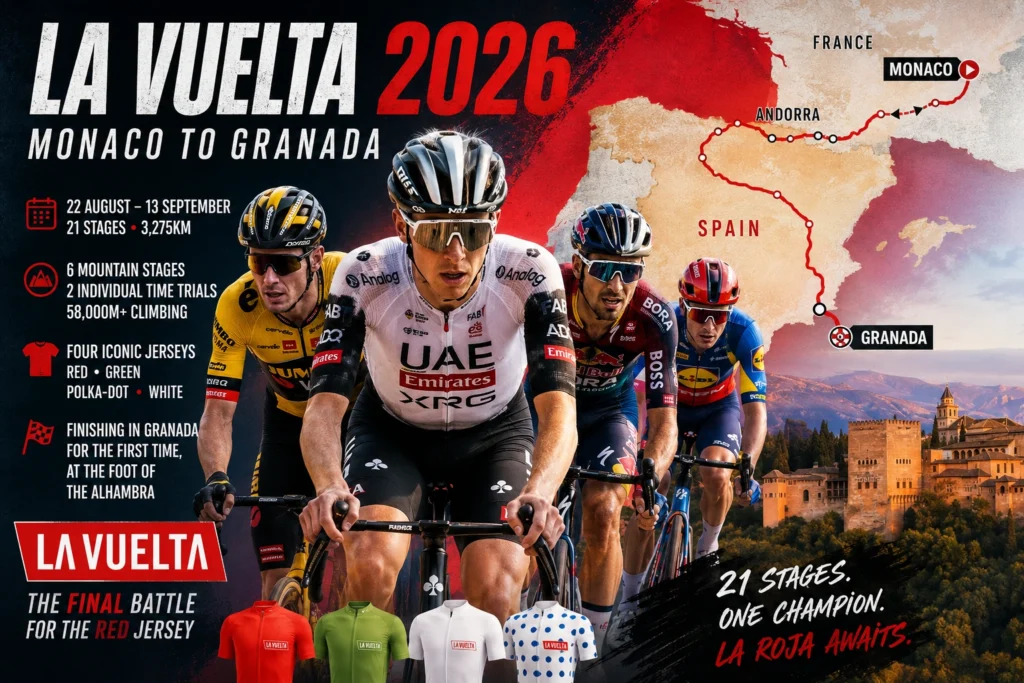
Cycling’s third and final Grand Tour of the season is almost here, and La Vuelta a España 2026 is shaping up to be one of the most intriguing editions in years.
The 81st edition of the Spanish Grand Tour runs from 22 August to 13 September, taking the peloton from Monaco through France, Andorra and Spain before finishing in Granada. The race features 21 stages, two individual time trials, six mountain stages and more than 58,000 metres of climbing.
For South African cycling fans, La Vuelta offers one final chance to watch the world’s best stage racers go head-to-head before the cycling season moves towards the World Championships. From Cape Town and Johannesburg to the cycling communities of the Western Cape and KwaZulu-Natal, there will be plenty to follow when the racing starts.
And there is a massive storyline at the front of the peloton: Tadej Pogačar is back at the Vuelta and is chasing the only Grand Tour title missing from his collection.
A Short History of La Vuelta
La Vuelta a España is the youngest of cycling’s three Grand Tours. The race was first held in 1935, after the Tour de France was established in 1903 and the Giro d’Italia followed in 1909.
The Spanish race initially struggled to match the prestige of its French and Italian rivals, but its status grew significantly over the decades. The move to its familiar late-August and September position on the calendar helped establish La Vuelta as the final Grand Tour of the season.
That timing also gives riders an important opportunity to build towards the World Championships.
The list of previous winners includes some of cycling’s biggest names, from Eddy Merckx and Bernard Hinault to Alberto Contador, Chris Froome and Primož Roglič.
Jonas Vingegaard added his name to that list in 2025, winning the 80th edition after the final stage was shortened in Madrid. João Almeida finished second and Tom Pidcock third.
The 2026 race will therefore be the 81st edition of La Vuelta.
La Vuelta 2026 Route: Monaco to Granada
The 2026 route breaks with tradition immediately.
The Gran Salida takes place in Monaco, where the race starts with a 9.4km individual time trial through the streets of the principality. The stage begins around Casino Square and includes several famous Monaco landmarks before finishing in the city.
That gives Monaco a unique place in cycling history. In 2026, it becomes the first city to host the opening stage of all three Grand Tours.
From Monaco, the peloton heads through France and Andorra before entering Spain.
The official route covers 3,275km across 21 stages and includes:
4 hilly stages
1 hilly stage with an uphill finish
4 flat stages
4 medium-mountain stages
6 mountain stages
2 individual time trials
2 rest days
The route also features more than 58,000 metres of total elevation gain, making this a particularly demanding edition of the Spanish Grand Tour.
The Big Mountain Stages
The mountains will almost certainly decide the red jersey.
Stage 3 finishes at Font-Romeu in the Pyrenees, while Stage 4 stays in Andorra. Stage 9 then provides another major GC test with the summit finish at Alto de Aitana.
The second half of the race gets even tougher.
Riders face mountain-top finishes at Calar Alto on Stage 12, Sierra de La Pandera on Stage 14, and Peñas Blancas on Stage 19.
Then comes the monster final mountain stage.
Stage 20 runs from La Calahorra to Collado del Alguacil, where the climb features sections reaching gradients of up to 20%. The route also includes a double ascent of Alto de Hazallanas, making it one of the most important stages of the entire race.
The time trial specialists will also have their opportunities. After the opening Monaco TT, Stage 18 offers another individual time trial covering approximately 32km from El Puerto de Santa María to Jerez de la Frontera.
Granada Finale
The 2026 Vuelta ends somewhere completely different from the usual Madrid finale. Stage 21 takes the riders from Carrefour Granada into Granada, with the final circuit taking the race towards the Alhambra.
It will be the first time Granada has hosted the final finish of La Vuelta, giving the race a spectacular backdrop for the crowning of the overall champion.
For South African viewers, that final stage could be particularly interesting because the overall battle may still be alive after Stage 20’s brutal mountain showdown.
The La Vuelta Jerseys Explained
Like the other Grand Tours, La Vuelta has several classification jerseys that riders fight for throughout the three weeks.
Red Jersey
The famous La Roja is awarded to the leader of the general classification. Unlike a simple stage-by-stage points competition, the GC is based on cumulative time. The rider with the lowest overall time leads the race.
This is the jersey Pogačar will have his eyes on from the opening time trial.
Green Jersey
The green jersey goes to the leader of the points classification. Riders earn points according to their finishing positions on stages and at intermediate sprints, making this classification particularly important for sprinters and versatile riders.
Polka-Dot Jersey
The blue polka-dot jersey belongs to the King of the Mountains. Climbing points are awarded at categorised mountain passes, with the classification often becoming a battle between breakaway specialists and GC contenders.
White Jersey
The white jersey is awarded to the best young rider in the general classification.
For 2026, the classification is open to riders born on or after 1 January 2001.
Tadej Pogačar the Man to Beat
It is difficult to look beyond Tadej Pogačar.
The Slovenian arrives in Spain after another extraordinary season. In July, he won his fifth Tour de France, joining Jacques Anquetil, Eddy Merckx, Bernard Hinault and Miguel Indurain on the record list for most Tour victories.
Now he is chasing the one major prize missing from his Grand Tour palmarès: La Vuelta a España.
Pogačar last raced the Vuelta in 2019, when he finished third and won three stages. His return seven years later has immediately made him the clear favourite.
He will also have a formidable UAE Team Emirates-XRG squad around him, including João Almeida, Jay Vine, Pavel Sivakov and Domen Novak.
Who Can Challenge Pogačar?
The field is not short of quality, even if several major names will be missing.
Jonas Vingegaard, the defending champion, will not return to defend his title. His 2026 season was interrupted by a fractured collarbone suffered in the Tour de France, and Visma-Lease a Bike confirmed that he will not race again this season.
Remco Evenepoel and Isaac del Toro are also not part of the Vuelta field, removing several riders who could have challenged Pogačar.
That leaves a fascinating group of contenders.
Felix Gall
Felix Gall is one of the most interesting names. The Austrian finished second overall at the 2026 Giro d’Italia, behind Vingegaard, and showed excellent climbing form throughout the Italian Grand Tour.
Gall has also already finished eighth overall at the 2025 Vuelta, so he knows what it takes to survive three weeks of Spanish racing.
He could be Pogačar’s biggest genuine GC challenger if he can reproduce his Giro form.
Mattias Skjelmose
Mattias Skjelmose is another rider worth watching. The Lidl-Trek leader brings a strong all-round game to a Vuelta route that includes climbing, time trials and punchy stages. He is also backed by a team featuring Mads Pedersen, giving Lidl-Trek plenty of firepower for the different types of stages.
Enric Mas
The Spanish fans will have plenty of reason to support Enric Mas. The Movistar rider has repeatedly performed well at his home Grand Tour and knows the Spanish mountains better than most of the international field. He remains one of the most experienced GC contenders in the race.
Primož Roglič
Then there is Primož Roglič. The four-time Vuelta winner is one of the biggest names in the race, but his situation is complicated.
Roglič suffered a training crash after being hit by a car and his participation was uncertain for much of the build-up to the race. Recent reports indicate that he is expected to start, although he is not currently expected to arrive with realistic GC ambitions.
If he can recover his form during the race, however, writing him off would be a mistake. Roglič has won La Vuelta four times for a reason.
Sprinters and Stage Hunters
The Vuelta is not only about the GC battle.
There are several opportunities for the sprinters, although the route is considerably more mountain-heavy than a typical Tour de France.
Mads Pedersen will be one of the biggest names to watch. The Lidl-Trek rider won the Vuelta points classification in 2025 and will be looking for more stage success this time around.
Wout van Aert also adds another dimension to the race. The Belgian can sprint, climb, time trial and attack from breakaways, making him one of the most versatile riders in the peloton. He is on the current Vuelta start list.
My Top Three Prediction
1. Tadej Pogačar
This is the obvious pick. The five-time Tour de France champion has the climbing ability, time-trialling strength and UAE team support to dominate this route. The big question is whether three weeks of racing in the Spanish heat can create an opening for his rivals.
Prediction: Winner
2. Felix Gall
Gall is my pick for second. His second place at the 2026 Giro shows that he can handle a Grand Tour GC battle, while the mountainous nature of this Vuelta suits his climbing strengths.
Prediction: Second
3. Mattias Skjelmose
Skjelmose gets my third podium spot. He has the versatility to limit his losses in the time trials and remain competitive when the road points upwards. If Pogačar dominates the mountain stages, the fight behind him could become extremely tight.
Prediction: Third
Roglič is the wildcard. If he arrives healthier and stronger than expected, he could easily disrupt this prediction.
What South African Cycling Fans Should Watch
For South African cycling fans, La Vuelta is a brilliant way to finish the Grand Tour season.
The race has everything that makes stage racing so addictive: brutal climbs, tactical breakaways, sprint finishes, time trials and the possibility of the red jersey changing hands when nobody expects it.
The southern Spanish route should also create a fascinating test of heat management. Riders will spend much of the second half of the race in Andalusia, where temperatures can become a major factor.
That makes La Vuelta 2026 particularly interesting for South African viewers. Anyone who has spent a summer afternoon grinding up a climb around Cape Town, Stellenbosch, the KwaZulu-Natal Midlands or the Garden Route will appreciate just how punishing a three-week Grand Tour can become when the heat turns up.
The action starts in Monaco on Saturday, 22 August, and finishes in Granada on Sunday, 13 September.
Pogačar wants the one Grand Tour title missing from his trophy cabinet. Gall wants to prove his Giro podium was no fluke. Roglič wants another chapter in his extraordinary Vuelta story. And somewhere in the mountains of Spain, one of them could make
FAQ
When does La Vuelta 2026 start?
La Vuelta 2026 starts on Saturday, 22 August 2026, with a 9.4km individual time trial in Monaco.
When does La Vuelta 2026 finish?
The race finishes on Sunday, 13 September 2026, in Granada, with the final stage taking the peloton towards the Alhambra.
Who is the favourite for La Vuelta 2026?
Tadej Pogačar is the clear pre-race favourite after winning his fifth Tour de France in July 2026.
How many stages are in La Vuelta 2026?
La Vuelta 2026 has 21 stages, including two individual time trials and six stages classified as mountain stages.
Who is predicted to win La Vuelta 2026?
Tadej Pogačar is the pick to win, with Felix Gall and Mattias Skjelmose my predictions for second and third.
Can South African fans watch La Vuelta?
South African cycling fans can follow La Vuelta through the relevant international sports broadcasting and streaming services available in South Africa, with coverage varying by broadcaster and subscription package.

Brett is the newest member of the writing team at NoBull Betting. He is known for his insights into Rugby and Football. Brett is fan of the Sharks in local rugby and a Chelsea man at heart in the English Premier League. He is a keen cyclist and enjoys a round of golf on the weekends.