FIFA Under Fire: Bias Accusations Rock the 2026 World Cup
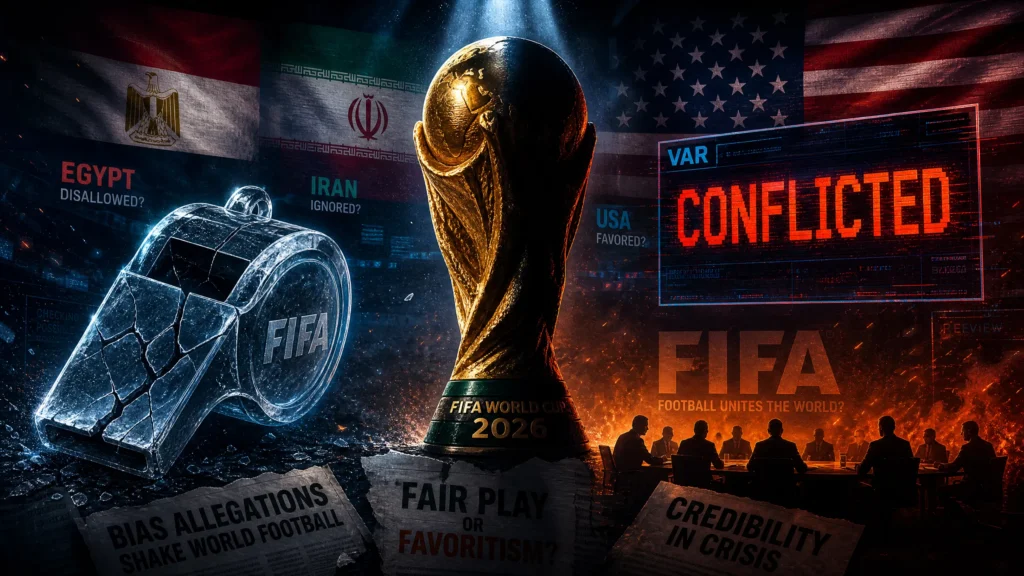
The 2026 FIFA World Cup should showcase the global game’s unifying power. Co-hosts United States, Mexico and Canada promised a tournament for the world. Instead, controversy has taken over. African and Middle Eastern federations, especially Egypt and Iran. Who now accuse FIFA of favouritism, double standards and political interference.
Egypt’s fury after a historic match
Egypt’s World Cup ended in heartbreak in Atlanta. The Pharaohs led Argentina 2-0 in their round-of-16 clash but then they collapsed. Argentina scored three goals in 13 minutes and won 3-2. The scoreline hurt Egyptian fans. The officiating hurt more.
The Egyptian Football Association (EFA) filed a formal complaint with FIFA. They demanded the removal of French referee François Letexier and his entire officiating team. They also called for an investigation into what they termed “double standards.” VAR had disallowed a Mostafa Zico goal that would have put Egypt 2-0 up. Late in the match, a similar incident involving Mohamed Salah went unreviewed. Argentina scored the winner in stoppage time.
Coach Hossam Hassan didn’t hold back. He accused football’s establishment of favouring Lionel Messi and the defending champions. Forward Mostafa Zico called the tournament “rigged.” Former Egypt striker Mido went further, accusing FIFA president Gianni Infantino of turning the World Cup into a purely commercial venture. FIFA’s chief of refereeing, Pierluigi Collina, rejected the claims. He insisted no one “not even the FIFA president” can influence match officials.
FIFA then appointed an all-Argentine officiating team for the France–Morocco quarter-final. That decision fuelled more debate about consistency and impartiality.
Iran’s long list of grievances
Egypt’s complaint centres on officiating. Iran’s dispute runs deeper. It involves logistics, visas, and what the Iranian federation calls fundamentally unequal treatment by co-host nation the United States. Authorities barred Team Melli from basing its training camp in Tucson, Arizona, as originally planned. The team had to operate out of Tijuana, Mexico for the entire tournament instead. Officials denied visas to fourteen Iranian backroom staff. These included federation officials and security personnel. Players themselves received travel documents only a week before the opening match.
Iran’s squad faced four-to-five-hour delays at the border before every match. Unlike other nations, they had to leave the United States the same evening they played. Captain Mehdi Taremi called it a “disaster World Cup” not because of results, but because of treatment. Iran’s football federation formally lodged a complaint with FIFA. They called the restrictions “inconsistent with the principle of providing equal conditions for all participating teams.” The U.S. Department of Homeland Security maintains that Iran agreed to the terms in advance. Still, the optics undercut FIFA’s claim of neutrality.
The Balogun-Trump controversy
One incident has damaged FIFA’s credibility more than any other: the case of USA striker Folarin Balogun. Balogun received a red card and an automatic one-match suspension. Due to a incident that took place during the USA’s win over Bosnia and Herzegovina. The U.S. President Donald Trump then personally called FIFA president Gianni Infantino to request a review. FIFA went on to clear Balogun to play against Belgium in the round of 16.
Trump publicly confirmed the call. He told reporters he didn’t think the challenge was a foul. FIFA’s disciplinary committee suspended the ban and let Balogun play. UEFA called the decision an unprecedented and unjustifiable “red line” crossing. Belgium’s football association tried to appeal, but FIFA however ruled they had no standing to do so. The decision sparked outrage across European football. Egyptian and Iranian officials now cite the episode as further proof that FIFA bends its rules when political or commercial interests are at stake.
A South African perspective
South African football fans still take pride in hosting the continent’s first World Cup back in 2010. These new controversies sting in a particular way. South Africa’s own tournament earned praise for its organisation and fairness. Bafana Bafana supporters have long championed African representation on football’s biggest stage. Now two of the sport’s most passionate footballing nations feel wronged by FIFA: Egypt from Africa, and Iran from a region with deep sporting and diplomatic ties to South Africa. Their accusations of bias have reignited debate across South African sports media. Many are therefore asking whether FIFA still treats all 48 competing nations equally.
Will FIFA act decisively on Egypt’s complaint? Or address Iran’s grievances? Will the Balogun affair leave lasting reputational damage? Those questions remain open. One thing is certain: on and off the pitch, the credibility of world football’s governing body faces its toughest test in years.
Brett is the newest member of the writing team at NoBull Betting. He is known for his insights into Rugby and Football. Brett is fan of the Sharks in local rugby and a Chelsea man at heart in the English Premier League. He is a keen cyclist and enjoys a round of golf on the weekends.